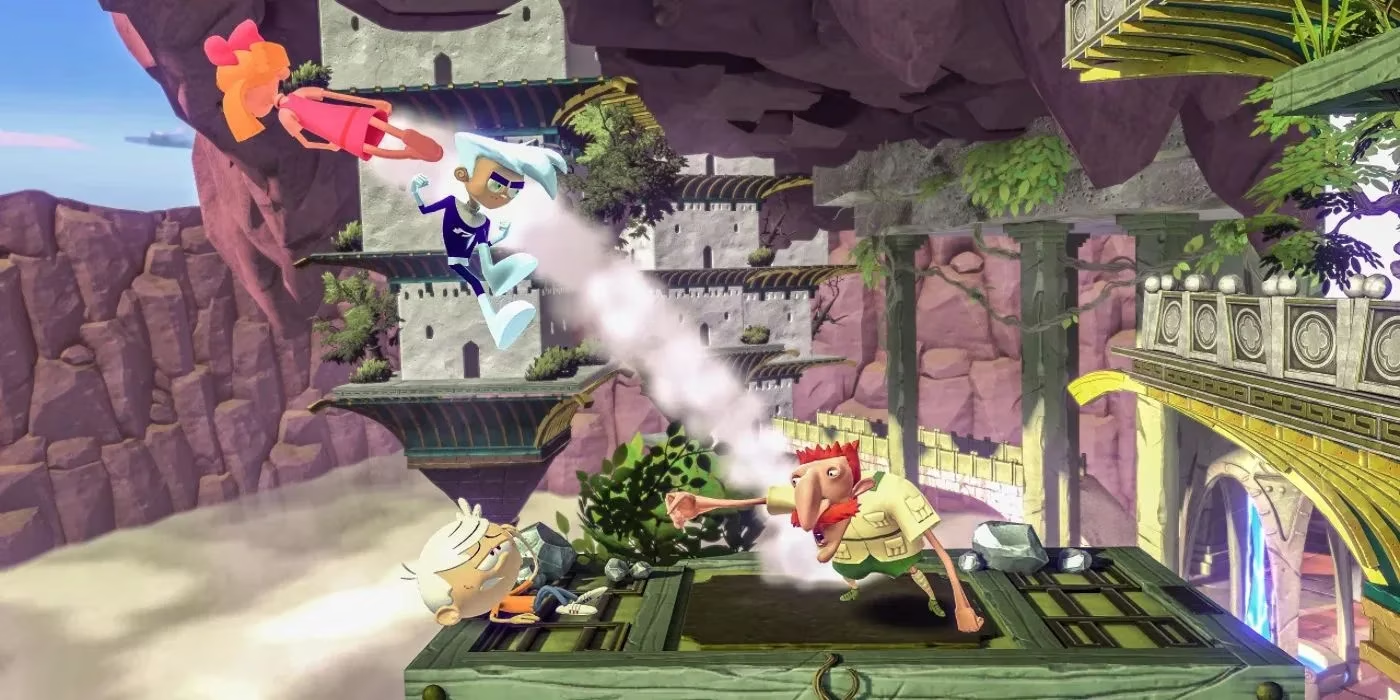
In a move that sent ripples through multiple gaming communities, the announcement of Nickelodeon All-Star Brawl was like finding a gourmet meal in a vending machine—unexpected, yet surprisingly sophisticated. 🤯 It captured the imagination of Nickelodeon fans dreaming of a cartoon crossover and raised eyebrows in the Super Smash Bros. arena, hinting at potential new competition. However, the most profound shockwave was felt within the core fighting game community (FGC). From the outset, developer Ludosity made their intentions crystal clear: this cartoon brawler was engineered from the ground up to be a serious, competitively viable contender, proving that depth can wear a colorful, nostalgic mask.
Nickelodeon's Competitive Vision: More Than Child's Play
When asked about the game's competitive prospects, Ludosity CEO Joel Nyström directly addressed the elephant in the room. He firmly dismissed any notion that Nickelodeon's younger demographic target would lead to a simplistic, casual-only experience. "Nickelodeon is absolutely on board with having the game be competitively viable," Nyström stated, emphasizing this commitment was foundational to the partnership. This wasn't a last-minute addition; it was the bedrock of the project. Ludosity was specifically chosen for this task because of their prior work on Slap City, a title deeply inspired by the mechanics of Super Smash Bros.. The collaboration was less a corporate mandate and more like a master watchmaker being given a box of rare, whimsical parts to assemble a precision timepiece.
Balancing Act: Fun for All, Deep for Masters
However, the developers were careful to frame their goals. Fellow developer Elias Forslind clarified that while competitive integrity is paramount, the sole aim wasn't to create an impossibly hardcore experience. The philosophy mirrors their work on Slap City: to craft a game that is universally enjoyable. Forslind humorously admitted he lacks the "mad skills" of top-tier fighting game pros, so he's dedicated to ensuring the game is a blast in chaotic, casual free-for-all matches too. The goal is a seamless spectrum of play, where the mechanics are as intuitive as riding a bike but possess the hidden complexity of a Swiss Army knife, revealing new tools the deeper you delve.
Creative Freedom: The Secret Sauce
A critical factor in the game's potential success is the creative autonomy granted to Ludosity. Nyström revealed that Nickelodeon has largely entrusted the studio to develop Nickelodeon All-Star Brawl as they see fit, particularly concerning gameplay mechanics. He noted that most gameplay ideas originated internally at Ludosity. This trust even extended to the character roster selection, with the development team providing significant input. This creative freedom is likely a key ingredient behind the game's diverse and surprising cast, allowing the developers to select characters not just for popularity, but for their potential to create unique and balanced fighting styles.

The FGC's High Bar: Promises vs. Execution
For the fighting game community, announcements of competitive intent are like seeds—promising, but requiring the right environment to grow. Simply stating a game will have "rollback netcode" (a crucial feature for smooth online play) and competitive depth is one thing; delivering a fully-featured, balanced, and sustainable competitive ecosystem is another. The FGC has learned that the absence of certain features in a titan like Super Smash Bros. does not set a low bar for newcomers. When a developer like Ludosity explicitly sets expectations for a competitive experience, the community's standards are immediately set high. They will scrutinize everything from frame data and movement options to online infrastructure and post-launch support.
The Road Ahead in 2025
Looking back from 2025, the journey of Nickelodeon All-Star Brawl has been a fascinating case study in bridging worlds. It demonstrated that a license often associated with childhood nostalgia could successfully host a serious competitive scene, provided the core mechanics are treated with respect and precision. The game's approach—building a deep technical foundation while wrapping it in accessible, chaotic fun—served as a blueprint for how to appeal to both casual audiences and dedicated competitors. Its legacy is a reminder that in the world of fighting games, true competition can flourish anywhere, even in the most colorful and unexpected arenas.