The year is 2026, and the shell-shocking heroes in a half-shell continue to captivate audiences. For an entire generation, the Teenage Mutant Ninja Turtles are more than just pizza-loving amphibians; they represent a portal to childhood, filled with the glow of arcade cabinets and the satisfying click of console controllers. While fans eagerly await new adventures, the journey often circles back to the classics. Why do these pixelated brawlers from decades past still hold such power over us? Could it be that the simple joy of battling the Foot Clan with friends is timeless?
Released in 2022, Teenage Mutant Ninja Turtles: The Cowabunga Collection served as the ultimate love letter to this legacy. It wasn't just a random assortment of old games; it was a carefully curated museum of turtle power, bundling a staggering 13 titles from the NES, SNES, Genesis, and Game Boy eras. This collection did more than just preserve history—it revitalized it with modern enhancements like high-resolution graphics and, crucially, online and couch co-op for several titles. It was the perfect stopgap for fans anxiously awaiting Shredder's Revenge, offering a masterclass in where the series had been.
🐢 The Crown Jewels: Arcade & Console Classics
At the heart of the collection were the legendary arcade conversions, the games that defined beat-'em-ups for many.
| Game Title | Platform (Original) | Key Feature |
|---|---|---|
| Teenage Mutant Ninja Turtles (Arcade) | Arcade (1989) | The primitive yet pioneering 4-player co-op classic. |
| TMNT: Turtles in Time (Arcade) | Arcade (1991) | Iconic time-traveling action with visuals that still pop. |
| TMNT IV: Turtles in Time | SNES | A superb home port of the arcade masterpiece. |
| TMNT: The Hyperstone Heist | SEGA Genesis | A Turtles in Time cousin with its own frantic pace. |
These games perfected the formula: choose your turtle (Leonardo, Donatello, Michelangelo, or Raphael), march to the right, and unleash shell-fu on endless waves of Foot Soldiers. Turtles in Time, in particular, remains a benchmark. Who could forget hurling Foot Soldiers at the screen with a cry of "Goongala!"? Its bright, comic-book style and fluid animations proved that great game design is eternal.
🔧 The NES Journey & a Game Boy Surprise
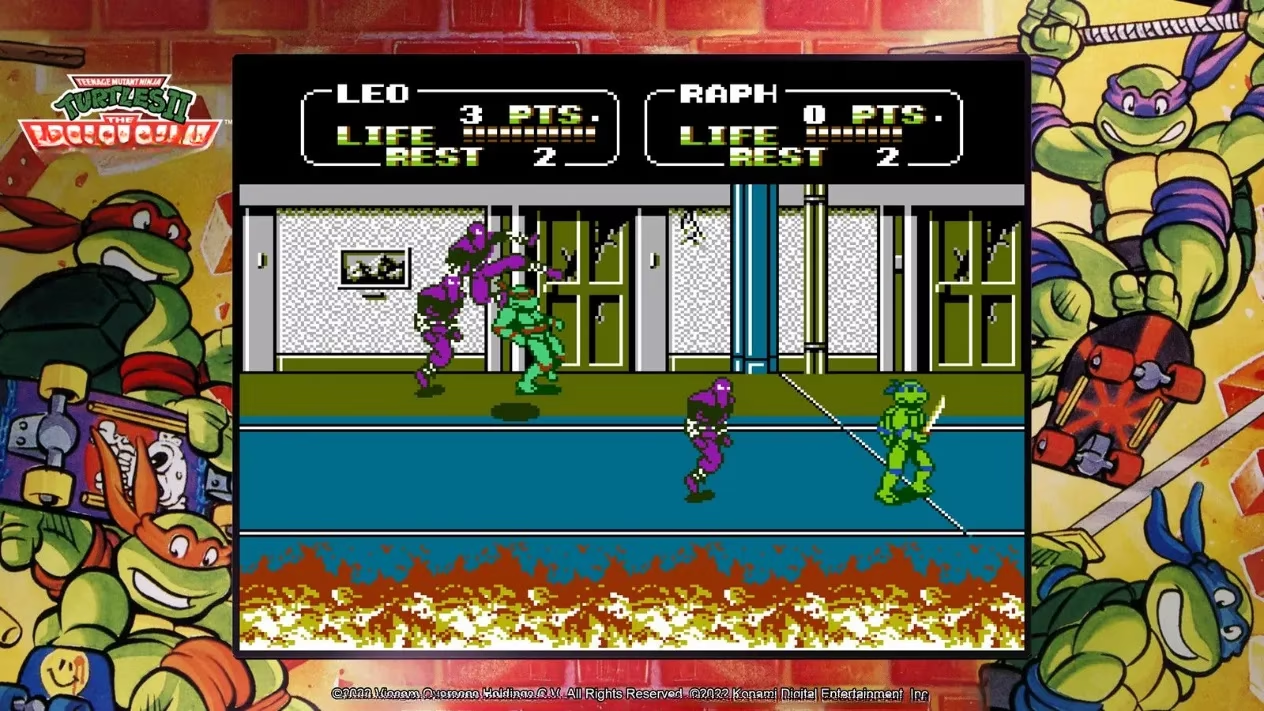
The collection also chronicled the Turtles' home console evolution. The often brutally difficult original NES game was there, alongside its more accessible sequels like TMNT II: The Arcade Game and TMNT III: The Manhattan Project. But the real hidden gem came from the Game Boy.
While Fall of the Foot Clan and Back from the Sewers offered portable brawling, TMNT III: Radical Rescue on the Game Boy was a revelation. This wasn't a simple beat-'em-up. It was an early Metroidvania-style adventure where you started as Michelangelo, rescuing your captured brothers one by one. Each turtle rescued wasn't just a life—it was a new key. Leonardo could drill through floors, Donatello could break certain walls, and their unique abilities allowed you to backtrack and unlock new areas. In a collection defined by nostalgia, Radical Rescue stood out as a surprisingly ambitious and inventive title that many may have missed the first time around.
👊 Tournament Fighters: The Fighting Game Trifecta
Then there were the fighters. The collection included all three distinct versions of TMNT: Tournament Fighters, each a fascinating snapshot of 16-bit fighting game design.
-
NES Version: Konami's final NES hurrah in the West, a technical marvel for the limited hardware.
-
SNES Version: The most robust package, with vibrant visuals, the most characters, and multiple game modes.
-
Genesis Version: Featured a more complex control scheme and a completely different story roster.
Each version had its own unique storyline, villains, and feel, making them not just ports but three separate games. Playing them back-to-back was a history lesson in how different console architectures and philosophies shaped game development.
🍕 A Legacy That Endures
Looking back from 2026, The Cowabunga Collection was more than a compilation; it was a foundation. It reminded players of the raw, cooperative fun that made the Turtles iconic and arguably set the stage for the triumphant reception of Shredder's Revenge that followed. The collection asked a simple question: what makes a TMNT game great? The answer was in every pixelated pizza slice and every thrown sai—it's about camaraderie, over-the-top action, and personality.
For long-time fans, it was a tidal wave of nostalgia. For newcomers, it was the perfect archive to understand why these heroes endure. In a gaming landscape filled with live-service models and hundred-hour epics, the Cowabunga Collection proved that sometimes, the purest joy comes from four turtles, a shared couch (or online lobby), and a simple command: "Cowabunga!" The shell has been passed, but the classics will always have a home.